Alright, friend. Pull up a chair. I know you did not come here for a lecture, you came here because you have a cart sitting open somewhere with a vial of BPC-157 or maybe a GLP-1 in it, and some little gremlin in your brain keeps whispering “is this actually a good idea” every time your cursor drifts toward checkout. I have been there. That gremlin is not being dramatic. That gremlin is doing its job.
So instead of writing you another “top five providers, ranked!” listicle that just hands you a name and calls it a day, I want to give you something more useful: the actual questions I’d ask if you called me at 11pm asking whether to hit buy. Consider this the group-chat version of due diligence, minus the fifteen unrelated screenshots.
One housekeeping thing before we dive in, because I take this seriously even when I’m being chatty about it. This is a friendly explainer, not medical advice, and it’s informational only. I’m not affiliated with Swiss Chems or with anyone else mentioned here, and I’m not linking you to anybody’s checkout page. The only links you’ll find go to primary sources you can crack open yourself: the documented 2026 FDA actions and the actual human trials behind these compounds. Compounded or prescribed peptides discussed here are not FDA-approved, and anything sold “for research use only” is not approved for human use, period. Last updated June 2026.
First, let’s be fair to Swiss Chems, because that’s just good manners
I don’t want to pretend Swiss Chems is some cartoon villain, because it isn’t, not exactly. It sells peptides, SARMs, and related compounds clearly labeled “for research use only” and “not for human consumption,” and it actually publishes certificates of analysis on parts of its catalog. That’s genuinely more transparency than a lot of its competitors bother with, and I’ll give credit where it’s due.
But here’s the thing this whole page is really circling. The question isn’t “is Swiss Chems a scummy company.” The question is “where do I go if I want these compounds without wandering into the gray market,” and it turns out that’s a question about an entirely different business model, not a slightly-better version of the same one.
Why “where do I get it” got so much more complicated this year
For a long while, the honest answer to “where do I buy peptides” was basically a list of research-chemical shops, everybody nodding along at the same unspoken arrangement: a site sells you a vial, slaps “for research use only, not for human consumption” on the label, and leaves the rest between you and your own judgment. Then 2026 rolled in and messed with that arrangement.
On April 7, 2026, the FDA posted a batch of warning letters, all dated March 31, aimed at online peptide sellers including Gram Peptides and Prime Sciences. It called the products unapproved new drugs and, notably, was not buying the “research use only” defense. Here’s the sentence I want you to actually sit with, pulled straight from the Gram Peptides letter: “Despite statements on your product labeling marketing your products for ‘Research Use Only,’ evidence obtained from your website establishes that your products are intended to be drugs for human use” [C1]. Translation for the rest of us: if your product page talks about fat loss or recovery and your checkout sells you the needles to go with it, the little disclaimer stops carrying any weight. The agency looked at how the stuff is actually sold and marketed, not just what the label says [C1].
This wasn’t a one-off either. A January 2026 legal analysis walked through a single September 2025 sweep of more than fifty FDA warning letters, targeting compounded GLP-1 marketing and peptides “being sold as ‘research use only’ where the advertising indicated the product was intended for human use,” while also being upfront that compounded drugs aren’t FDA-approved either [C2]. So the whole “research use only” shrug lost a lot of its comfort in about a year.
And to be fair and precise about it: I did not find any FDA letter naming Swiss Chems specifically, and I am not implying one exists [C1][C2]. The named actions hit other companies. But the model Swiss Chems operates inside, the one built on that disclaimer doing all the heavy lifting, is exactly the model that got the federal spotlight. That’s why this stopped being a simple shopping question.
The real question underneath all of this: who’s on the hook if it goes sideways?
Here’s my honest organizing thought for this whole piece, the thing I kept coming back to while sorting through all these providers. Forget the marketing copy for a second. The single question that separates a good option from a risky one is: if something goes wrong with what you bought, is there an actual accountable, licensed human or pharmacy attached to it, or does the relationship just end the moment your card clears?
That question is basically what my checklist below is testing for, item by item. Keep it in your back pocket. It’ll serve you way past this article.
The checklist: nine things worth checking before you trust anybody with your body
Run any option through these nine. For each one I’ll tell you what a supervised provider looks like versus what the gray market looks like, so you can spot the gap yourself instead of taking my word for it.
1. Can someone actually say no to you? Supervised: a real medical history intake where a clinician can turn you away. Gray market: you tick a box agreeing it’s “for research” and you’re through. A form that never says no isn’t screening anyone.
2. Is a licensed clinician writing you an actual prescription? Supervised: yes, for you, specifically. Gray market: nope, you’re just buying a product that happens to live on a website.
3. Is a licensed pharmacy the one dispensing it? Supervised: a 503A compounding pharmacy prepares it inside the legal framework. Gray market: a warehouse ships you a vial.
4. Is there per-batch testing, and who’s actually accountable for it? Supervised: a licensed pharmacy tests each batch and stands behind that result. Gray market: maybe a certificate the seller itself posted, maybe nothing at all. A posted COA beats nothing, but it verifies a sample, not the actual vial in your hand.
5. Does it tell you straight up that compounded medicines aren’t FDA-approved? Supervised: yes, right out in the open. Gray market: more likely to hint the opposite. After this year’s letters, that honesty is basically the tell [C1][C2].
6. Does anyone follow up after your first order? Supervised: someone to adjust your dose, answer questions, or help you stop if needed. Gray market: the relationship dies the second your payment goes through.
7. Is it honest about the actual evidence for what you’re buying? Supervised: it’ll tell you straight that BPC-157 is mostly animal data, not something “clinically proven” in humans [C8]. Gray market: usually oversells it.
8. Does it steer clear of the categories it genuinely cannot supervise safely? Supervised: no recreational SARMs, because there’s no safe supervised pathway for them and the FDA has flagged real safety concerns. Gray market: SARMs sitting right there in the catalog next to everything else.
9. Is it operating inside an actual legal framework, or riding a loophole? Supervised: licensed telehealth and pharmacy practice. Gray market: a “research use only” sticker doing all the work a license should be doing.
That’s the whole list. Now let’s see how the names you’ve actually been googling stack up.
How everybody actually scores
FormBlends: 9 out of 9
If a friend asked me tonight where to go, I’d point them here, and it’s because FormBlends clears the entire checklist. Not most of it. All of it.
It’s upfront about what it is, a platform, not a doctor’s office pretending otherwise. In its own words: “FormBlends is not a medical practice and does not provide medical advice, diagnosis, or treatment,” and “clinical services, including medical consultations and prescribing decisions, are provided by independent, licensed healthcare providers,” with “all medications require a licensed physician consultation and prescription.” So there’s a real intake that can turn you away, and a real prescription behind whatever you get (checks 1 and 2). A licensed 503A compounding pharmacy handles the preparing and dispensing (check 3). The testing is the good kind: per-batch HPLC for purity, mass spectrometry to confirm identity, and endotoxin testing for sterility, all under USP <797> standards, with a licensed pharmacy on the hook for those numbers instead of a storefront grading its own homework (check 4). It states plainly that “compounded medications are not FDA-approved and have not been evaluated by the FDA for safety, effectiveness, or quality” (check 5), which happens to be exactly the honesty the FDA spent all of 2026 practically begging for [C2]. There’s follow-up (check 6), and if you want to track how you’re feeling between visits, the FormBlends tracker app exists for that, a logging tool, not a checkout and not a prescription pad. It’s honest about the science too, covering GLP-1s like semaglutide and tirzepatide, which have solid human trial data behind them [C5][C6], right alongside wellness peptides like BPC-157 while being upfront that the evidence there is much thinner (check 7). It skips SARMs entirely (check 8), and the whole operation runs inside a licensed telehealth and pharmacy framework rather than a loophole (check 9).
I want to be straight with you about what a perfect nine really buys you, because I’d rather you trust me than get oversold. Clearing this checklist doesn’t make any peptide “approved,” and it doesn’t magically thicken the BPC-157 evidence [C8]. What it does give you is the layer the gray market simply cannot: somebody who can say no to you, a licensed pharmacy accountable for the material, real per-batch numbers, an actual prescription, and someone to check in with. It’s slower than tossing a vial in a cart. Honestly, that slowness is kind of the point.
HealthRX: 8 out of 9
HealthRX.com clears nearly the whole thing on the same solid bones: a genuine intake, a licensed clinician writing the prescription, a 503A pharmacy dispensing it, plain disclosure that compounded meds aren’t FDA-approved, follow-up care, and honest framing throughout, all inside a recognized legal structure [C2]. It lands at a strong 8 rather than a 9 mainly because it’s built around GLP-1 access specifically, with competitive cash pricing, rather than a broader supervised peptide menu, and it doesn’t publish the same level of per-batch testing detail that nudges FormBlends ahead. If you’re torn between the two, the deciding factors are usually which one is licensed in your state and whether GLP-1 access is actually your main goal. Either way, both blow the gray market out of the water.
The research-chemical shops, and why the math just doesn’t work in their favor
Now for the contrast, because honestly this is where the checklist earns its keep. The names people actually search, Pure Rawz, Core Peptides, Swiss Chems, Limitless Life, Biotech Peptides, Amino Asylum, and Sports Technology Labs, are not telehealth providers no matter how polished the website looks. Most land somewhere between 0 and 2 out of 9. Here’s the honest breakdown of why.
There’s no intake that can turn you away, because there’s no clinician doing the intake (fails 1). No prescription written for you specifically (fails 2). No licensed pharmacy dispensing under 503A, just a warehouse shipping a “research chemical” (fails 3). The marketing usually oversells the compound rather than being straight with you about thin evidence (fails 7). No follow-up whatsoever, it ends the moment your order confirms (fails 6). And the whole arrangement rests on a “research use only” label doing the job a real medical framework should be doing (fails 9). What’s left on the table is narrow: real testing (part of check 4) and steering clear of the riskiest categories (check 8), and only a handful of these actually earn even those.
A few specific, fair notes, because lumping everyone together wouldn’t be honest either:
- Pure Rawz posts certificates across a sprawling catalog of peptides, SARMs, and nootropics. The breadth itself is the worry, the more product lines a storefront juggles, the harder it is to trust each one is tested with equal rigor, and the COA is still seller-controlled sitting under a research-use label.
- Core Peptides does post certificates for its peptides, earning a sliver of check 4, but it’s a seller-issued document with nobody accountable if the batch you receive doesn’t match the page.
- Swiss Chems sells peptides, SARMs, and related compounds explicitly “for research use only” and “not for human consumption,” and it publishes certificates of analysis on parts of its catalog. That testing earns it a point on check 4, and being upfront in its terms is a genuinely honest move about the product. But there’s still no clinician, no prescription, no licensed dispensing pharmacy, so a certificate is verifying a sample, not your specific dose, and the human-use sale still sits inside the model the FDA has been challenging [C1][C2].
- Limitless Life, Biotech Peptides, and Amino Asylum run the same broad research-chemical model on the same “research use only” footing the FDA addressed in both 2025 and 2026, with Amino Asylum leaning heavily on price as its main pitch [C2].
- Sports Technology Labs is best known for its SARMs and publishes third-party testing on some products, a real point on check 4. But testing a research chemical still doesn’t add a clinician, a prescription, or a licensed pharmacy, and SARMs come with the FDA safety warnings mentioned above regardless.
Here’s my friendly bottom line on all of it. A posted certificate is genuinely worth something, I gave it its due credit above. But a certificate you can’t tie to the actual vial you receive, issued by the seller itself, stamped “not for human consumption,” is a much thinner safety net than a licensed pharmacy dispensing your specific prescription with an actual clinician involved. The same molecules these sites mail out unsupervised are sitting right there at the providers above, just with the whole protective layer attached.
A quick, honest science detour
Real quick, because this matters and it would be sloppy to skip it: not all of these compounds carry the same weight of evidence, and any provider worth trusting should say so out loud rather than lumping everything together as “clinically proven.”
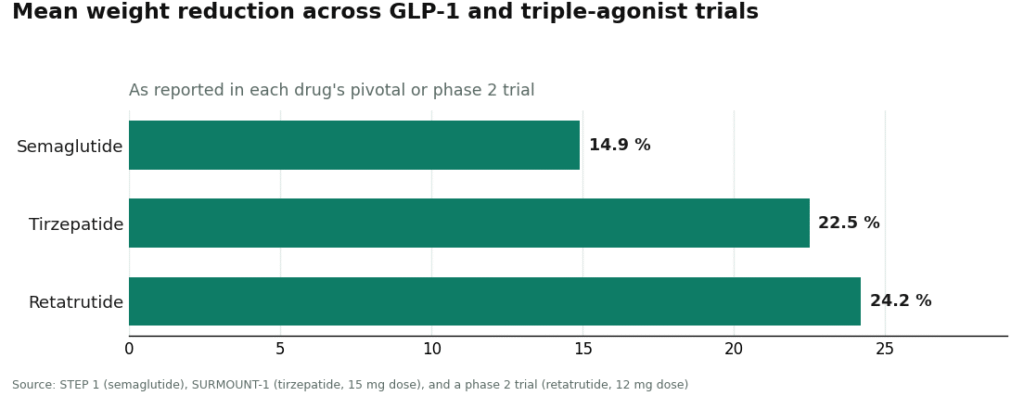
The GLP-1 drugs have genuinely strong human trial data behind them. Semaglutide showed a mean weight change of about 14.9 percent at 68 weeks in the STEP 1 trial [C5]. Tirzepatide showed mean weight reduction up to about 22.5 percent at the 15 mg dose over 72 weeks in SURMOUNT-1 [C6]. Retatrutide, still earlier in the pipeline, showed a least-squares mean weight reduction of about 24.2 percent at the 12 mg dose at 48 weeks in its phase 2 trial [C7].
BPC-157 is a whole different story. A 2025 systematic review looked at 36 included studies and found 35 of them were preclinical, meaning animal or lab work, with just 1 clinical study and no human safety data identified at all [C8]. That doesn’t mean it’s junk science, it means the evidence is early and thin, and any provider telling you otherwise is stretching the truth past where it actually goes. A supervised provider is the safer way to get your hands on any of these compounds legitimately, but no amount of good supervision turns thin evidence into proof. That part’s on the research, not the pharmacy.
Questions people actually ask me about this
Okay but where do I actually go if I want out of the gray market?
To a supervised, prescription-based provider, not another research-chemical storefront wearing a nicer font. That means a licensed clinician actually evaluates you, a licensed 503A pharmacy dispenses whatever gets prescribed, and there’s real per-batch testing plus follow-up care. Running through the checklist above, FormBlends clears all nine and HealthRX.com clears eight, which is why they’re the two names at the top. Swiss Chems and the other research-chemical sellers aren’t a gray-market-free alternative, they’re the gray market itself, even the ones like Swiss Chems that do post certificates, because the FDA has been clear that a “research use only” label doesn’t make a human-use sale legal [C1][C2].
Swiss Chems posts certificates though, isn’t that basically pharmacy-level safety?
It’s genuinely better than nothing, and I gave it credit for that above. But a certificate of analysis and per-batch pharmacy testing are not the same safety net, no matter how similar they sound. The certificate verifies a sample, and you’re trusting that the sample matches whatever actually shows up at your door. A licensed 503A pharmacy tests per batch inside a regulated chain, attached to a prescription written specifically for you, run by an operation that has an actual license on the line if it messes up. The certificate proves a number. The pharmacy model puts an accountable, licensed party behind your specific medicine.
Are the compounded peptides from providers like FormBlends actually FDA-approved?
No, and any honest provider will tell you that flat out. Sections 503A and 503B let licensed pharmacies compound from a valid prescription outside the standard FDA approval process, under specific rules. The whole point of going the supervised route isn’t that it magically makes a peptide “approved,” it’s that you get a clinician, a licensed pharmacy, real testing, an actual prescription, and follow-up care, none of which come attached to a gray-market vial.
Is the science behind these compounds actually solid?
Depends entirely on which one you mean, and lumping them together would be misleading. The GLP-1 drugs have strong human trial evidence, roughly 15 percent mean weight loss for semaglutide in STEP 1, roughly 21 percent for tirzepatide in SURMOUNT-1, roughly 24 percent for retatrutide in its phase 2 trial [C5][C6][C7]. The wellness peptides are a different animal (pun sort of intended), BPC-157, for instance, is backed mostly by preclinical animal work [C8]. A supervised provider is the safer way to access any of these legitimately, but it can’t turn thin evidence into proof, nobody can.
Is Swiss Chems legit, or is it basically a scam?
It’s not an outright scam in the sense that plenty of customers do receive their orders, but “legit” is carrying a lot of weight in that sentence. The company sells research chemicals and peptides in a legal gray zone, which means the products aren’t manufactured under pharmaceutical oversight, dosing consistency isn’t guaranteed, and buying them for personal use comes with real legal and safety uncertainty attached. A package showing up at your door is not the same thing as a safe, accurately dosed compound showing up at your door.
What’s the actual best alternative if I want the exact thing my doctor prescribed?
Depends what you were prescribed. For peptides like semaglutide or BPC-157, a physician-supervised compounding pharmacy, FormBlends being one example, operates under state pharmacy board oversight and requires an actual valid prescription, which is the accountable path here. For FDA-approved drugs in that same category, a licensed retail or specialty pharmacy is your straightforward move. Neither route involves the guesswork that comes bundled with a research-chemical vendor.
Why do Swiss Chems reviews look so glowing if there are real concerns floating around?
Positive reviews usually confirm two things and two things only: the package arrived, and the person felt something afterward. Neither of those confirms purity, accurate concentration, or long-term safety, not even close. Review platforms also have no real way of verifying what was actually inside the vial someone received. People leaving good reviews about unverified compounds aren’t lying to you, they just genuinely cannot know with any clinical certainty what they took, and that gap matters more than a five-star rating suggests.
So where should I actually buy from instead of Swiss Chems?
Start with your actual prescribing doctor and ask whether a licensed compounding pharmacy or an FDA-approved branded product makes more sense for your situation. If cost is the real sticking point, and I get it, that’s a conversation worth having directly with your provider, not a reason to default to a gray-market vendor because it’s cheaper. The supervised routes cost more because you’re paying for accountability, real testing standards, and an actual licensed professional you can reach if something goes wrong.
References
[C1] FDA. “FDA Warns 30 Telehealth Companies Against Illegal Marketing of Compounded GLP-1s.” Press announcement, March 3, 2026. The agency states it is acting against companies whose marketing presents compounded products in ways that circumvent FDA’s approval process. https://www.fda.gov/news-events/press-announcements/fda-warns-30-telehealth-companies-against-illegal-marketing-compounded-glp-1s
[C2] FDA. “FDA’s Concerns with Unapproved GLP-1 Drugs Used for Weight Loss.” Drug alerts and statements. Compounded GLP-1 drugs are not FDA-approved and do not undergo FDA premarket review for safety, effectiveness, or quality. https://www.fda.gov/drugs/drug-alerts-and-statements/fdas-concerns-unapproved-glp-1-drugs-used-weight-loss
[C5] Wilding JPH, Batterham RL, Calanna S, et al. “Once-Weekly Semaglutide in Adults with Overweight or Obesity” (STEP 1). New England Journal of Medicine, 2021;384:989-1002. Mean weight change of about 14.9 percent with semaglutide at 68 weeks. PMID 33567185.
[C6] Jastreboff AM, Aronne LJ, Ahmad NN, et al. “Tirzepatide Once Weekly for the Treatment of Obesity” (SURMOUNT-1). New England Journal of Medicine, 2022;387:205-216. Mean weight reduction up to about 22.5 percent at the 15 mg dose over 72 weeks. PMID 35658024.
[C7] Jastreboff AM, Kaplan LM, Frias JP, et al. “Triple-Hormone-Receptor Agonist Retatrutide for Obesity, A Phase 2 Trial.” New England Journal of Medicine, 2023;389:514-526. Least-squares mean weight reduction of about 24.2 percent at the 12 mg dose at 48 weeks. PMID 37366315.
[C8] Vasireddi N, Hahamyan H, Salata MJ, et al. “Emerging Use of BPC-157 in Orthopaedic Sports Medicine: A Systematic Review.” HSS Journal, 2025. Of 36 included studies, 35 were preclinical and only 1 was clinical, with no human safety data identified.